
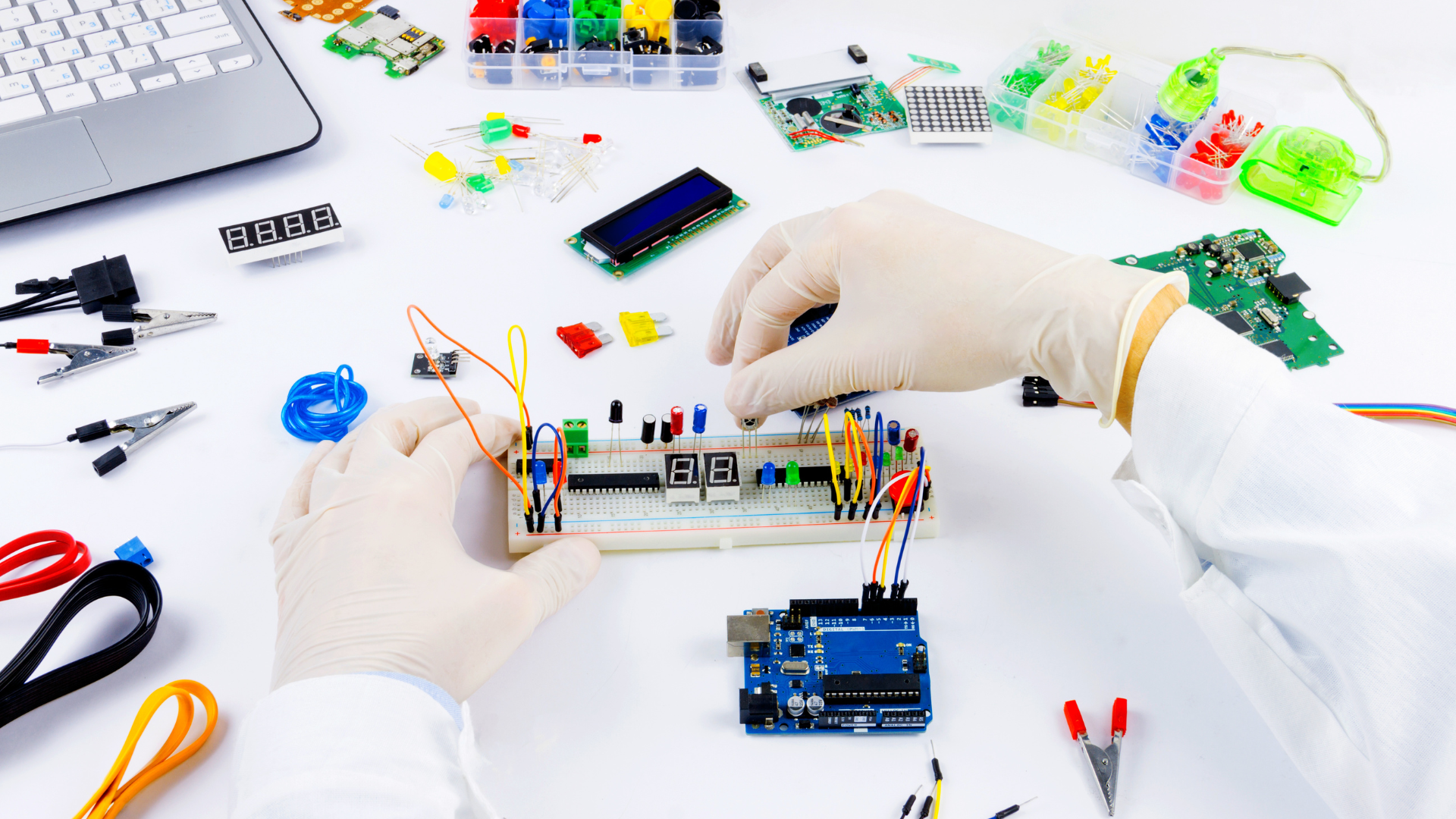
Embedded Systems Bootcamp
Deep dive into embedded systems with ARM architecture, RTOS, bare-metal programming, and real-time applications. Learn to build firmware for critical systems with hands-on experience in debugging and optimization.
Duration
5 Months
Format
On Campus
Projects
12+ Projects
Certificate
Included
Course Curriculum & Skills
A comprehensive curriculum designed to take you from fundamentals to advanced concepts with hands-on practice.
Digital Electronics & Microprocessor Architecture – Understanding of binary systems, logic gates, flip-flops, registers, and microprocessor fundamentals including CPU architecture and instruction sets.
ARM Cortex-M Architecture – Deep dive into ARM Cortex-M core architecture, memory organization, exception handling, NVIC, and processor modes.
Embedded C Programming – Mastering embedded C including pointers, structures, bit manipulation, volatile keyword, memory-mapped I/O, and writing efficient embedded code.
STM32 Microcontroller Development – Hands-on development with STM32 microcontrollers using HAL and LL libraries, GPIO, timers, interrupts, and peripheral configuration.
Bare-Metal Embedded Programming – Writing firmware without an operating system, startup code, linker scripts, memory management, and direct hardware control.
Real-Time Operating Systems (RTOS) – Implementing FreeRTOS for task management, scheduling, inter-task communication, semaphores, mutexes, and queues.
Peripheral Interfacing – Working with UART, SPI, I2C, CAN, USB, ADC, DAC, PWM, and DMA for communication and data transfer.
Device Driver Development – Writing device drivers for sensors, displays, storage devices, and communication modules at the register level.
Interrupt Handling & Real-Time Constraints – Designing interrupt service routines, managing interrupt priorities, and meeting hard real-time deadlines.
Power Management Techniques – Implementing low-power modes, sleep states, clock gating, and optimizing for battery-powered applications.
Embedded Linux Fundamentals – Introduction to embedded Linux, kernel configuration, device tree, building custom Linux images with Yocto/Buildroot.
Debugging Tools & Techniques – Using JTAG/SWD debuggers, logic analyzers, oscilloscopes, serial monitors, and GDB for embedded debugging.
Memory Management & Optimization – Understanding stack, heap, static memory allocation, memory alignment, and optimizing code for limited resources.
Communication Protocols Implementation – Implementing UART, SPI, I2C, Modbus, and custom protocols from scratch at the driver level.
Bootloader Development – Writing custom bootloaders for firmware updates, secure boot, and application programming.
Embedded Security – Implementing secure boot, cryptographic algorithms, secure communication, and protecting firmware from attacks.
PCB Design Basics – Introduction to schematic capture and PCB layout for embedded systems using tools like KiCad or Altium Designer.
Capstone Project – Designing a complete embedded system from hardware selection through firmware development, testing, and deployment.
What You'll Learn
Design and develop firmware for ARM Cortex-M microcontrollers from scratch
Implement real-time operating systems (FreeRTOS) for complex embedded applications
Write efficient bare-metal code with direct hardware register manipulation
Develop device drivers for various peripherals and communication interfaces
Debug embedded systems using JTAG, logic analyzers, and advanced debugging tools
Optimize code for memory-constrained and real-time environments
Implement secure boot and cryptographic features in embedded systems
Design complete embedded systems from hardware selection to firmware deployment
Career Outcomes
Upon completion, you'll be ready for roles such as:
Ready to Get Started?
Join our next cohort and transform your career in 5 months.